Weekly Newsletter, 5.11.26
Much has happened since my last newsletter. I will start with the bad news.
On April 29th, the Supreme Court dealt a devastating blow to the Voting Rights Act (VRA) in Louisiana v. Callais. In a 6-3 decision, the Court effectively gutted Section 2 of the VRA, which prohibits voting practices that discriminate on the basis of race or language. For decades, this provision allowed voters to legally challenge racially gerrymandered redistricting maps that dilute minority votes and inhibit the ability of minority voters to elect the candidate of their choice by “packing” too many into single districts or “cracking” them across several districts. The Supreme Court ignored the plain letter of the VRA and intent of Congress, finding that Section 2 violations can only be proven where there is a discriminatory intent, even when there is a discriminatory impact. This makes Section 2 merely impossible to enforce. You can read my initial reaction here.
Callais has deep implications for minority voting rights and representation across the country and, in the words of the three dissenting Justices, “this latest chapter in the majority’s now-completed demolition of the Voting Rights Act,” which began with Shelby County v. Holder in 2013. My Congressional Black Caucus colleagues from Louisiana, Representatives Troy Carter and Cleo Fields, discussed the stakes of the Callais decision before the ruling in this New York Times op-ed, warning that Louisiana legislators seemed “eager to create a new map that dismantles our majority-Black districts and disperses our current constituents across predominantly white districts,” and that “without the Voting Rights Act, state leaders seem intent on denying Black voters fair representation.” The Supreme Court has now unleashed them to do just that, and states in the Deep South are responding with deliberate speed.
The Louisiana governor declared a state of emergency and postponed House primary elections set for May 16, ignoring the tens of thousands of ballots that had already been mailed in as the state legislature began considering maps that could eliminate one or both of the seats held by Reps. Cartier and Fields.
The Tennessee legislature cracked Black voters in Memphis across three congressional districts to eliminate the sole majority-Black seat in that state.
Beyond redistricting, the Callais decision will make it harder to legally challenge voting practices that have a discriminatory impact on minority voters. I cannot help but remember that the very literacy test my great-grandfather took in Alabama and the poll taxes my father and grandfather paid to the state of Tennessee were on their face race-neutral in an effort to comply with the 15th Amendment, but were implemented to disenfranchise Black voters. That’s exactly why Section 2 of the VRA was enacted.
For over 20 years, I have fought to protect and expand voting rights in the General Assembly and in Congress, and I will not stop now. With bills like the John R. Lewis Voting Rights Advancement Act, I’ll continue fighting alongside advocates, fellow lawmakers and public officials to restore gutted voting rights protections and defend the progress that has allowed my family and millions of other Americans to exercise our constitutional rights to participate in our democracy.
Meanwhile, chaos continued to reign in Washington as House Republicans fought over reauthorization of Section 702 of the Foreign Intelligence Surveillance Act (FISA), their partisan Farm Bill and Department of Homeland Security (DHS) Funding. You can read a good summary of the House Republican dysfunction here.
On a brighter note, King Charles III addressed a joint session of Congress in honor of America’s 250th birthday before visiting Front Royal, Virginia and Shenandoah National Park. I shared my thoughts on the King’s visit and the special relationship between the United States and the United Kingdom with BBC World Service.
Keep reading to learn what else you may have missed since my last newsletter.
ENERGY & COMMERCE UPDATE: ADDRESSING RISING ENERGY DEMAND, SKYROCKETING ENERGY PRICES AND THE CHALLENGES OF AI
With the U.S. households having on average 21 connected devices and the rapid growth of AI, we have seen a proliferation of data centers that is only expected to increase. Each of the over 4,000 data centers in the U.S. use enough electricity to power up to 100,000 households. Virginia alone contains nearly 600 of them, making our Commonwealth the data center capital of the world. These facilities keep our increasingly digital world moving, but their impact on the rapid spike in energy demand has sparked concerns over land use, environmental impact and rising costs for consumers and other businesses. Up to 25% of Virginians struggle to pay their utilities, forced to choose between keeping the lights on or putting food on the table.
Meanwhile, President Trump’s war of choice in Iran has driven gas prices up to $4.30 a gallon and threatens to send the entire world into a fuel shortage. This crisis has been met with zero action from Congress, as the Trump Administration and Congressional Republicans eliminate investments in clean and renewable energy sources and energy efficiency programs that would help us meet rising demand affordably.
During an Energy Subcommittee hearing entitled “AI and the Grid: Meeting Growing Power Demand while Protecting Ratepayers,” I discussed these concerns and asked energy industry leaders what action this moment necessitates.
I also joined Congress Walker to discuss my takeaways from the hearing and how Virginia can be a leader in this space.
I discussed the need for government and private industry to work together to proactively meet the moment, remain a leader on the global stage and solve these big-picture problems at the 2026 CTIA 5G Summit.
CELEBRATING SMALL BUSINESSES AND COMMUNITY PROJECTS FUNDING BACK IN THE TRI-CITIES AREA
During the House recess last week, I visited the Tri-Cities to distribute Community Project Funding and celebrate Small Business Week.
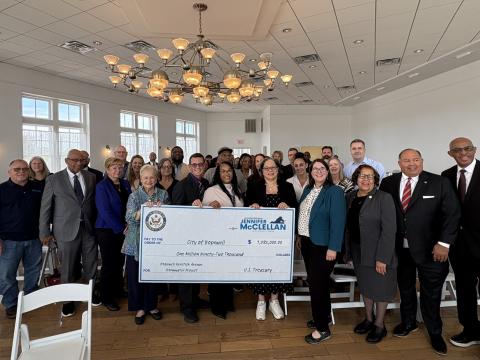
Earlier this year, I secured over $10 million in community project funding for 14 projects in Virginia’s Fourth District through the completion of the Fiscal Year 2026 (FY26) appropriations process. During the District Work Period, I presented over $1 million to the City of Hopewell for infrastructure improvements to the Heretick Avenue stormwater project, which you can read more about here and here.
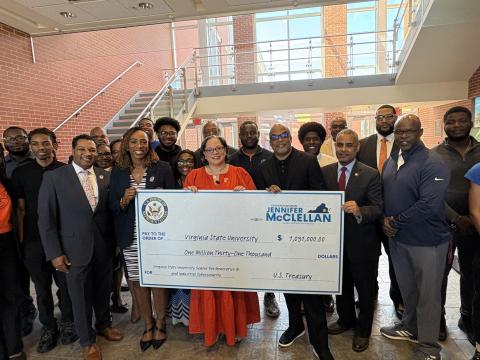
I also presented over $1 million to Virginia State University’s School of Engineering to help establish their new Center for Generative AI and Industrial Cybersecurity, which you can read more about here. Students in the School of Engineering demonstrated some of the AI projects they are working on this year.
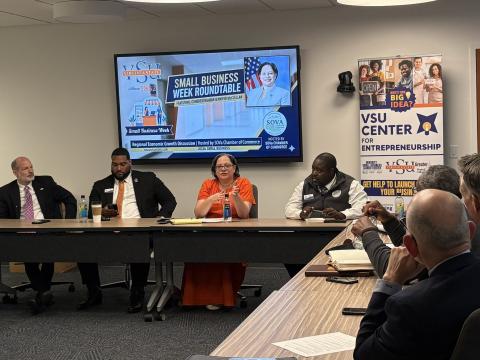
While at Virginia State, I also celebrated Small Business Week by hosting a small business roundtable with the Southern Virginia Chamber of Commerce and visiting the Small Business Vendor Fair at Virginia State University. During each, I asked small business owners to share challenges they face and what the federal government can do to help support them. They identified access to health care as a challenge, particularly now that the enhanced premium tax credits under the Affordable Care Act have expired. They also identified access to capital, recruiting and retaining workers, and access to childcare as challenges.
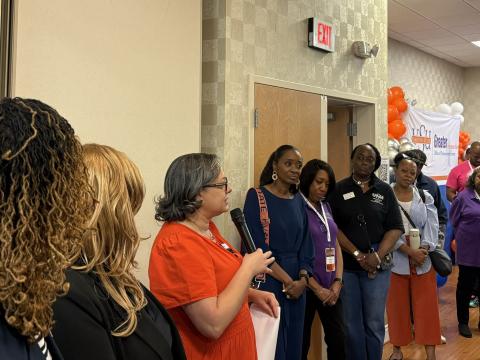
Many childcare providers are also small businesses, and while in Hopewell, I attended the ribbon-cutting for Tiny Treasures Child Care and Learning Center. The owner, Tyesha Evans, also shared her thoughts on how the federal government can support small businesses like hers.
I also made sure to stop by one of my favorite takeout spots in the district: Ettrick Deli in South Chesterfield! They have dutifully served the community for decades as a small business that prides itself on its Philly cheesesteaks.
MY BRIGHT SPOT: SPOTLIGHTING A FELLOW HISTORYMAKER ON MOMENTS WITH MCCLELLAN
My latest episode of Moments with McClellan dropped! Just in time for Teacher Appreciation Week, I spoke with Rep. Jahana Hayes (CT-05): the first Black woman elected to represent Connecticut in Congress, a fellow mom, 2016 National Teacher of the Year and one of my favorite people to sit with on the House floor!
Watch the full episode to learn why we call her the Congressional Martha Stewart, how the role of an educator overlaps with the role of a public servant and more.
REMINDERS
Join me TONIGHT at 7 PM for a tele-town hall where I’ll answer questions, share an update on my work in Congress and hear from you about the issues you care about! You can RSVP here by 2:30 PM to participate directly, or you can watch a livestream on my website or Facebook page.

Applications are now open through Friday, October 30th for Service Academy Nominations!
Stay tuned for more updates and keep the faith, friends!