Weekly Newsletter, 3.12.26
During a short legislative session last week, Trump Administration officials provided a classified briefing to members of Congress that provided no clarity on the imminent threat to the United States, our troops or national security interests that justified strikes on Iran, the goals or long-term plan for ending the resulting war in the Middle East. As explained in last week’s newsletter, the War Powers Act of 1973 only permits the President to deploy our armed forces without Congressional authority in response to an attack or imminent threat of an attack on the United States, its territories or armed forces. To date, the Administration has given conflicting and insufficient explanations for its actions, as summarized here and here.
Congressional Republicans blocked House and Senate resolutions to begin terminating offensive troop activity in Iran without Congressional approval. I cosponsored and voted for the House resolution. In any event, the War Powers Act requires the Administration to cease troop deployment by May 1st unless Congress declares war, authorizes continued action or grants a 60-day extension.
Rather than holding the Trump Administration accountable for its actions in Iran, Congressional Republicans sought to use the ongoing war to push through a funding bill for the Department of Homeland Security that provides no guardrails to rein in an out-of-control ICE and Border Patrol. I voted no, supporting instead an alternative bill to fund every DHS agency except for ICE and Border Patrol — which received nearly $200 billion under the Big Ugly Law signed last year — while negotiations continue on reforms to those agencies.
In the midst of all this, President Trump fired Secretary of Homeland Security Kristi Noem. For months, I have called for Secretary Noem to be fired or impeached for her disastrous tenure that created a public safety crisis resulting in the deaths and violent mistreatment of people across our nation. The President’s proposed replacement, Oklahoma Senator Markwayne Mullin, shows no signs that he will change course. A leadership change in name only does not go nearly far enough to prevent the pain and suffering in our communities from continuing.
On Saturday, I joined Rev. Al Sharpton to discuss Iran, DHS funding, Secretary Noem’s firing and more on PoliticsNation.
Keep reading to learn what else you may have missed since my last newsletter.
E&C COMMITTEE UPDATE: FIGHTING TO PROTECT KIDS ONLINE AND PIPELINE SAFETY
For months, Republican and Democratic leadership on the Energy & Commerce Committee negotiated legislation to address the risks kids and teens face online and in an increasingly digital world. Last week, Committee Republicans abandoned those talks to push forward several partisan bills that fail to meet the mark and would actually make things worse.
Everyone agrees that we must prioritize children’s safety online in a rapidly changing technological landscape. Congress has the power to minimize the risks teens and kids face as they grow up as digital natives in a space that older institutions can sometimes struggle to understand. But Congress has not kept up with the oversight needed to protect them from online harm.
Committee Republicans advanced bills that let big tech off the hook by preempting state laws that adopt stronger protections for kids and allowing tech and data collection companies to avoid liability by claiming they lacked actual knowledge or willfully disregarded knowledge that kids use their platforms. The bills also allow parents complete access and control over their teens’ online existence, even when abusive or threatening. I spoke against these bills in committee.
Fortunately, the Committee also advanced bipartisan energy cybersecurity bills, including my bipartisan bill with Rep. Miller-Meeks to help rural utilities defend against potential cybersecurity risks and cyberattacks. Our bill, the Rural and Municipal Utility Cybersecurity (RMUC) Act, would reauthorize the Rural and Municipal Utility Advanced Cybersecurity Grant and Technical Assistance Program, originally created under the Infrastructure Investment and Jobs Act, and authorize $250 million over five years to support deployment of advanced cybersecurity technologies and participation in information-sharing programs. I look forward to seeing this legislation make it to the House floor and hopefully be signed into law to strengthen our nation’s energy grid.
You can watch the full committee meeting and learn more about the bills advanced here.
The Energy Subcommittee also held a pipeline safety hearing last week to consider a partisan bill to reauthorize the Pipeline and Hazardous Materials Safety Administration (PHMSA) that, contrary to what Republicans on the committee claim, actually weakens safety and environmental protections.
PHMSA oversees a 3.3-million-mile-long pipeline network that transports oil, natural gas and hazardous chemicals across the country, and was last authorized and funded in the Protecting Our Infrastructure of Pipelines and Enhancing Safety (PIPES) Act of 2020. That authorization expired over two years ago. While the House Transportation and Infrastructure Committee and the Senate Commerce Committee have advanced bipartisan legislation to maintain pipeline oversight and additional funding to maintain and modernize existing pipeline infrastructure, the partisan bill put forth by E&C Republicans rolls back PHMSA’s ability to conduct routine oversight. I joined my fellow Democrats on the committee to oppose this bill.
On a positive note, last Wednesday, I introduced the bipartisan AI-Ready Networks Act with Rep. Obernolte, who also serves on the Energy & Commerce Committee. The AI-Ready Networks Act prompts the National Telecommunications and Information Administration (NTIA) to issue a forward-looking report on the integration of AI into commercial telecommunications networks across the country.
AI’s impacts on our workforce cannot be overstated, and we must act now to ensure these changes both strengthen our telecommunications ecosystem and benefit the American people. This bipartisan bill will ensure Congress has the information it needs to assess best practices for the use of AI, support innovation in telecommunications networks and improve transparency for the public.
SECURING OVER $10 MILLION FOR COMMUNITY PROJECTS ACROSS VA-04
As a member of Congress, I can advocate for funding for various community projects in my district through the appropriations process. For Fiscal Year 2026 (FY26), each House member could request funding for up to fifteen projects in their district in certain categories for state and local governments and eligible non-profit entities.
As part of the final FY26 appropriations bills passed, I successfully secured $10,149,000 in funding for 14 projects throughout Virginia’s Fourth District ranging from wastewater and stormwater management, to research at our state universities, to transportation infrastructure. These projects will improve the water we drink and use, make our roads safer and invest in our higher educational institutions to put Virginia on the cutting-edge of technological innovation and advancement.
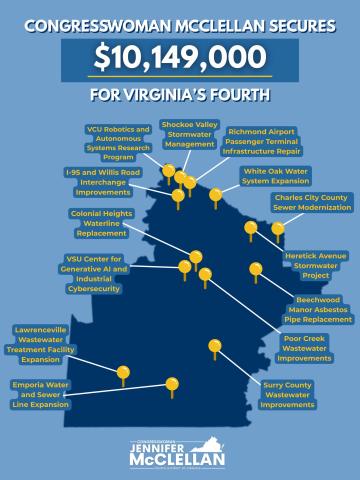
I offer my thanks to Senators Warner and Kaine for their partnership in securing this funding, and I look forward to seeing these projects come to fruition!
MY BRIGHT SPOT: CELEBRATING A HISTORYMAKER DURING WOMENS HISTORY MONTH
On Monday, March 2nd, I witnessed history at the investiture of Judge Cleo Powell as the first Black woman Chief Justice of the Supreme Court of Virginia after being unanimously selected by her peers on the Court.
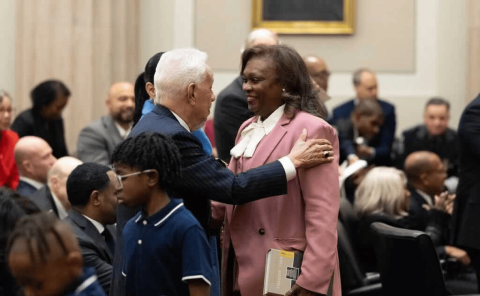
Born in Brunswick County, Chief Justice Powell decided at age 13 to become a lawyer. After graduating with her bachelor’s and law degrees from the University of Virginia, she worked as a labor and employment lawyer at Hunton & Williams law firm in Richmond. She then worked in the Office of the Attorney General under Mary Sue Terry and at Virginia Power. In 1993, she began a judicial career spanning each level of Virginia’s judicial branch, serving as a General District Court Judge and Circuit Court Judge for Chesterfield and Colonial Heights, the first Black woman on the Virginia Court of Appeals and the Supreme Court of Virginia.
I was honored and beyond thrilled to see Chief Justice Powell step into this new role, and I have every confidence that she will exceed all expectations for years to come!
REMINDERS
Submit an original piece of artwork for the 2026 Congressional Art Competition, an annual program cultivating artistic talent whose winner will see their artwork displayed in the U.S. Capitol! Open to any high school (grades 9-12) artists living in Virginia’s Fourth Congressional District, the deadline is April 20th, 2026 by 5:00 PM.
Stay tuned for more updates and keep the faith, friends!